by Sara Süess – EAWAG/Switzerland
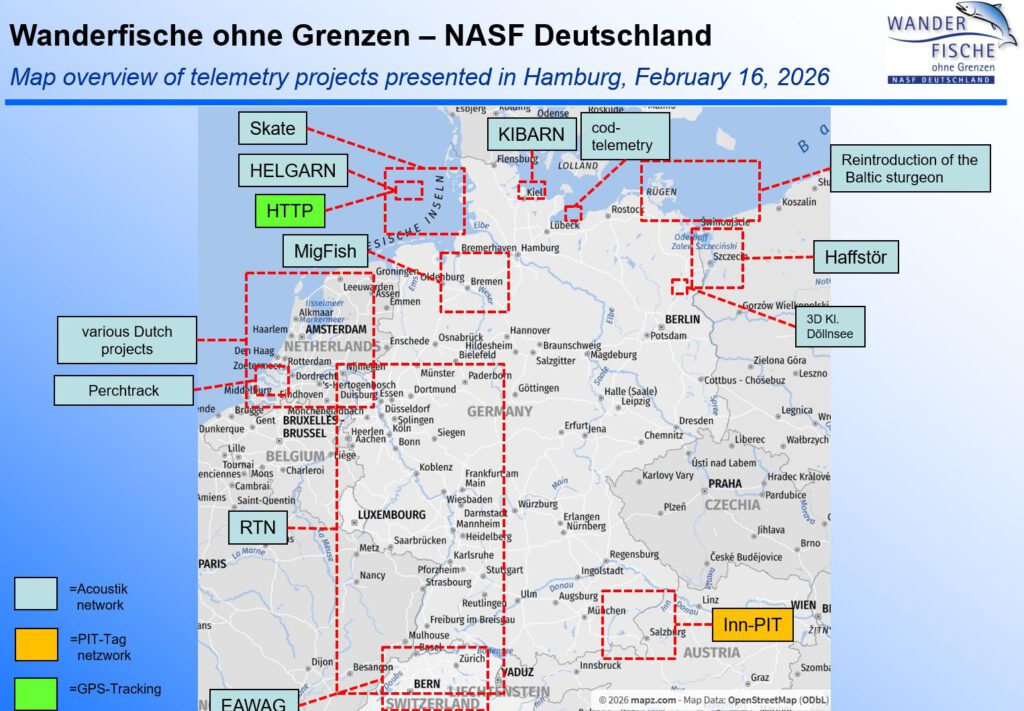
Since 2025, the Swiss network for studying fish migration has been recording fish movements using around 140 acoustic receivers. More than 750 fish from 13 species have already been fitted with transmitters. But fish know no borders – their migrations do not stop at national boundaries or within a single water system.
To close the gap between the Swiss network and the existing networks in the Dutch Rhine delta, Eawag has installed acoustic receivers at 13 additional sites along the German Upper Rhine. The first data readouts are still pending. This makes it all the more exciting to find out which fish – from Switzerland, but also from the Rhine delta – will be detected in future, and which connections exist between the different river sections.
Further migratory fish projects are also about to get under way: in an eel migration project carried out in collaboration with Eawag (https://fischwanderung.ch/aal/), preparations are currently under way to tag hundreds of silver eels in the High Rhine. Their migration and mortality are to be tracked on their way towards the Sargasso Sea. In addition, in cooperation with various environmental consultancies and the Federal Office for the Environment (FOEN), there are plans to fit transmitters to juvenile salmon stocked in Switzerland. The aim is to document their downstream migration towards the Atlantic and any obstacles along the way.
What do the data so far reveal about fish movements in Switzerland?
Initial analyses show that most of the recorded movements take place in free-flowing river sections. Movements across hydropower plants, by contrast, have rarely been observed. So far, there have generally been no clear differences between upstream and downstream movements. The eel is an exception: in its case, passages at hydropower plants have so far been recorded exclusively in the downstream direction.
There are also interesting differences between species. While carp are regularly on the move, wels catfish often stay in one place for long periods – for example under a tree or in suitable cover. Despite this site fidelity, however, they can be strong swimmers and cover great distances. Some catfish, for instance, remained at the same location for months before subsequently migrating around 30 kilometres.
Overall, only a few very long migrations have been detected so far. One of the exceptions is an eel that covered a distance of 95 kilometres. Distances of around 30 kilometres have been observed in catfish, barbel, perch and grayling, among others.
The next question: where do the long migrations take place?
The first observations suggest that longer migrations take place mainly in free-flowing river sections. Whether this trend can be statistically confirmed, and what role modified sections and hydropower plants play in longer migrations, remains to be shown by the statistical analyses still to come. The results will help us better understand how far fish migrate, which habitats they connect and to what extent artificial barriers restrict their movements.
Extending the acoustic network beyond national borders opens up new opportunities to investigate precisely these questions. This will allow us to better understand how far fish actually migrate, which connections exist between habitats and where obstacles limit their migrations.