Telemetry Network Germany takes shape
On February 16, 2026, scientists and stakeholders working on the topic of fish migration in Germany met in Hamburg. There are now a large number of projects dealing with fish migration. Acoustic telemetry in particular offers great potential for synergy if the various projects are aware of each other and coordinate informally and technically. This primarily concerns detections from other project areas, of course, but also the closing of gaps in the network of existing receiving stations.
There was broad agreement at the meeting that cooperation is definitely desirable and should be promoted.All database information about the locations of receiving stations and project content is to be stored in the ETN (European Tracking Network).
In addition, there should be a know-how exchange for the various fields of knowledge related to telemetry. This covers topics such as operating techniques for specific fish species, deployment and testing of receiving stations, but also knowledge transfer for applying for permits.
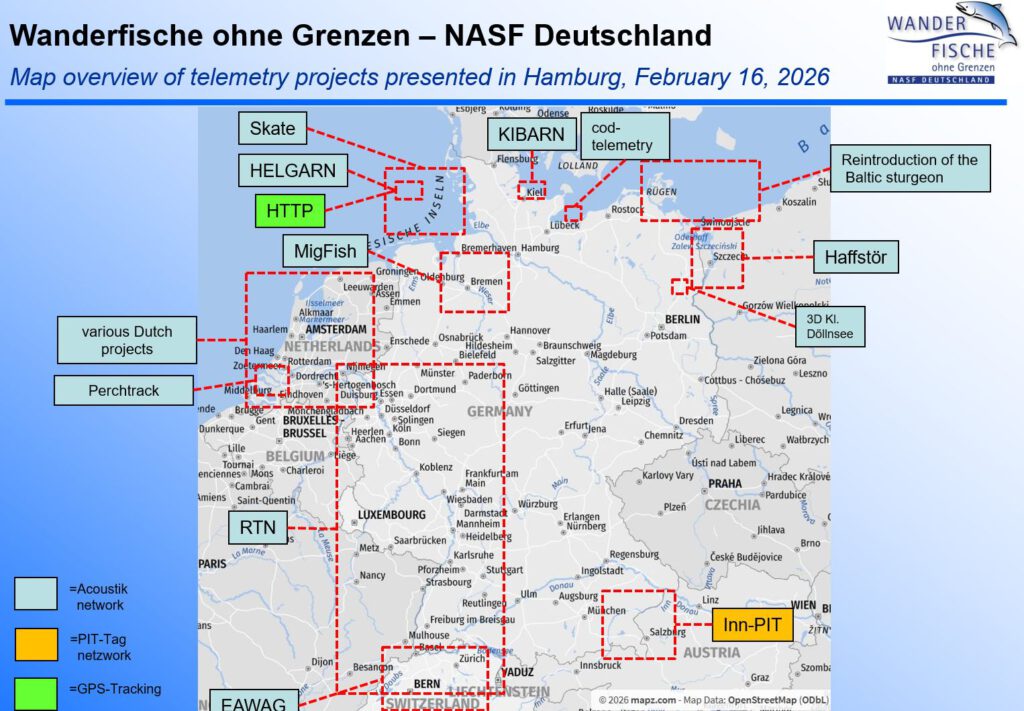
The following projects were presented in 5-minute presentations:
- The “MigFish” project by Lasse Marohn from the Thuenen Institute. This acoustic telemetry network uses 22 Innovasea and 9 Thelma (TBR 800) receivers along the Weser River. Additional 20 receivers are being provided by the Federal Office of Hydrology to set up acoustic receivers in tributaries such as the Aller and Wümme rivers. The aim is to track twait shad, sea lamprey, river lamprey, and burbot.
- Stefanie Felsing from the MV State Research Institute reported on the telemetry projects on Baltic sturgeon in the Baltic Sea.
In the wild, the fish are tracked using GPS tracking and acoustic telemetry to find out what challenges they face on their migration routes and to adapt stocking concepts. In September 2022, 145 sturgeons equipped with acoustic transmitters were released into the Baltic Sea. There are 19 receivers (Thelma TBR800) at 12 locations. She mentioned as a problem that the transmitters do not always have unique ID codes (across providers) and that this can lead to duplicate detections that are inconclusive. The acoustic telemetry network is to be maintained for at least 15 years. - Christoffer Nagel from the Technical University of Munich (TUM) presented his large-scale PIT tag study in the Inn River (“Inn-PIT”). Thirty-eight antennas have been installed in the river, tributaries, and fish migration aids along a 150-kilometer stretch of the river. Twelve fish species were tagged with PIT tags, totaling 28,000 individuals. There were a total of 3,000,000 detections and the detection rate was 34.2%. The study lasted 10 years. Fish measuring 81-1200 mm (Mühlkoppe-Huchen) were tagged.
- Camille Musseau from IGB Potsdam reported on the “HaffStör” project, which is closely coordinated with the aforementioned activities in the Baltic Sea. A “heat map” of the preferred habitats is being created within the Szczecin Lagoon using acoustic telemetry. This showed that the western part of the lagoon is irrelevant for sturgeon migration. The 47 receivers used, manufactured by Thelma (type TBR 800), receive three different frequencies (66, 67, and 71 kHz) in order to obtain as many detections as possible
- Felix Mittermayer from Geomar reported on the projects “SCHUFI – supporting the development of monitoring and protection concepts for fish” and “HELGARN – the Helgoland Acoustic Receiver Network.” The latter is a dense network of receivers that are deployed on the seabed using ships and cameras to monitor their exact location. In this area, it is important to ensure that the receivers are well placed on rocky ground and can be retrieved. This installation is part of a larger overall project, the “DTO (Digital Twin of the Ocean)” within the framework of the ETN. The aim is to investigate the effects of structural changes in the sea, such as wind farms, and their influence on fish migration. In addition, there is a network of acoustic receivers in Kiel Bay called “KIBARN (Kiel Bight Acoustic Receiver Network)”.
- Natalie Klinard from Geomar reported on her experiences with the acoustic telemetry network of the “GLATOS (The Great Lakes Acoustic Telemetry Observation System)” project, a collaboration between the USA and Canada on the Great Lakes. Here in Germany, she has worked on an acoustic network at Lake Müggelsee. She is currently working on the “TrackdAT” project, which aims to make the available scientific literature on telemetric studies accessible.
- Stephanie Haase from the Thünen Institute reported that she is researching the population development of herring, flatfish, and cod in the Baltic Sea. A cod telemetry field with 30 receivers has been set up in the Bay of Lübeck near Boltenhagen to understand the decline in cod populations.
- Matthias Schaber from the Thünen Institute in Bremerhaven reported on his telemetry study called “http” (Helgoland Tope Tagging Project) on dogfish near Helgoland using GPS transmitters. Migrations from Helgoland to southern Spain were documented. Bavarian Radio has produced a film on this topic.
- Stefan Ludwig from the nature conservation organization “Wanderfische ohne Grenzen” (Migratory Fish Without Borders) presented his knowledge of migratory fish projects on the Rhine and Weser rivers. In the Rhine catchment area, there are a number of projects in the Netherlands that deal with the migration of various fish species. Rob Kroes is a scientist who works for ATBK (Adviesbureau voor Toegepaste Kleinschalige Biologie) on an acoustic network that extends to the German border. He plans to expand this network into Germany in cooperation with German projects from North Rhine-Westphalia. In Switzerland, the EAWAG project “Climate change and fish movement patterns” from the south of the Rhine is pursuing similar efforts towards the north, so that it will be possible to track migrations in the Rhine from the sea to the large Swiss tributaries Aare and Reuss. Both activities are currently being implemented. The receivers work with “Open Protocol” or are to be converted to “Open Protocol” and come from Thelma, Innovasea, or Lotek. A map of the network is available online.
- Ryo Futamura from IGB Potsdam reported on a long-term 3D telemetry project in the small Döllnsee lake, which belongs to the IGB and is free from any use (see also …). Twenty receiving stations are permanently installed there and track movement patterns. He also reported on a collaboration with Dutch sport fishing clubs called “Perchtrack,” which uses acoustic telemetry to track large perch. A total of 72 perch over 40 cm in length have been fitted with acoustic transmitters from Lotek and have also been given Floy tags that are visible from the outside. Anglers are asked to report recaptures to www.sharkray.eu and then release the fish back into the water. In the Haringsvliet and Hollandsch Diep (branches of the Rhine delta), 80 receiving stations have been attached to buoys to determine the movement patterns of the perch.
- Anna Schukat from the Alfred Wegner Institute reported on the “Skate” project, which plans to install an acoustic receiver network in the German Bight for a long-term study. The aim of this project is to identify and eliminate the reasons for the decline of spiny dogfish and native ray species in accordance with IUCN guidelines.