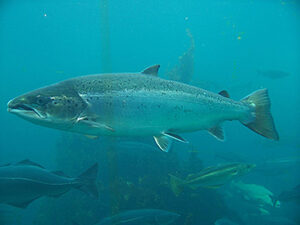
The Atlantic salmon (Salmo salar) is the largest representative and namesake of a group of fish known as salmonids, which also includes our native brown trout.
Its original range in Europe extends from northern Portugal to the Kola Peninsula in northern Russia. In North America, it ranges from the state of New York to northern Canada, as well as Greenland, Iceland, and the Faroe Islands. It thus populated the entire North Atlantic region.
Germany is therefore located in the center of its European range. A hundred years ago, salmon were still at home in most German rivers, and the Rhine was the river with the richest occurrence of Atlantic salmon worldwide.
In addition to its high numbers, the Rhine salmon was distinguished by the particular size of the individual fish.
The scientific name “salmo salar” means “jumping salmon.” For our ancestors, it was not unusual to see these large and magnificent fish jumping in German rivers.
 © Stefan Ludwig
Salmon are long-distance migratory fish. They are born in oxygen-rich streams, where they spend their first weeks protected among the pebbles through which clear water flows.
After one to two years in fresh water, they transform and become smolts.
They take on their typical silver color and embark on a long journey through the rivers to the sea.
The Atlantic salmon (Salmo salar) is the largest representative and namesake of a group of fish known as salmonids, which also includes our native brown trout.
Its original range in Europe extends from northern Portugal to the Kola Peninsula in northern Russia. In North America, it ranges from the state of New York to northern Canada, as well as Greenland, Iceland, and the Faroe Islands. It thus populated the entire North Atlantic region.
Germany is therefore located in the center of its European range. A hundred years ago, salmon were still at home in most German rivers, and the Rhine was the river with the richest occurrence of Atlantic salmon worldwide.
In addition to its high numbers, the Rhine salmon was distinguished by the particular size of the individual fish.
The scientific name “salmo salar” means “jumping salmon.” For our ancestors, it was not unusual to see these large and magnificent fish jumping in German rivers.
Salmon are long-distance migratory fish. They are born in oxygen-rich streams, where they spend their first weeks protected among the pebbles through which clear water flows.
After one to two years in fresh water, they transform and become smolts.
They take on their typical silver color and embark on a long journey through the rivers to the sea.
In the North Atlantic off Greenland, around the Faroe Islands and Iceland, the growing salmon spends one, two or more years feeding on krill and small fish. Well-fed and equipped with sufficient fat reserves, it makes its way back to its birthplace, where it mates and gives life to a new generation of young salmon.
Most of the parent fish die after spawning. Only a few manage to make the long and dangerous journey to the North Atlantic a second or even third time.
Due to its physique, the salmon is particularly well equipped to swim against strong currents. On its migration, it orientates itself to the main current in the river. Hydropower plants therefore represent a particularly dangerous obstacle for salmon.
History
Historical stocks in Germany
Just 100 years ago, most German rivers were home to large numbers of salmon. Every year, they would swim upstream to lay their eggs on the gravel beds of streams and rivers.
People at that time were able to catch large numbers of salmon for consumption without endangering the sustainability of the stock.
In the Migratory Fish Internet Database, you can access historical records that give an impression of how abundant the stocks were at that time.
In the Fulda River near Kassel, for example, a fisherman caught 798 salmon with a single net haul on June 5, 1443.
At the end of the 19th century, between 40,000 and 80,000 Rhine salmon were sold every year at the fish market in Rotterdam alone.
The salmon was extinct!
By around 1950, the salmon had become extinct in Germany!
Water pollution and water engineering had brought about the demise of this proud fish.
After several decades of human activity, all that remained of the once abundant stocks and wild rivers were often fishless, concrete-lined sewers.
The “king of fish” and its entourage of many small and large aquatic creatures died silently and simply disappeared.
Delicacy
Salmon as food and delicacy
Salmon has always been of outstanding importance for the diet of people in Central Europe.
For geological reasons, the center of Central Europe is an iodine-deficient area. Only through migratory fish, especially salmon and sea trout, were the people of that time able to meet their needs with the iodine-rich meat of these tasty fish and avoid the well-known symptoms of iodine deficiency, such as goiter formation and metabolic disorders, and even mental retardation.
It is therefore no exaggeration to say that salmon played a key role in the development of humans and human civilization in Central Europe.
Today, this necessity no longer exists and salmon is considered a delicacy in the human diet.
Large-scale farming of farmed salmon has caused prices to fall, and for many people it has become commonplace to eat farmed salmon.
At the same time, genuine wild salmon is almost unavailable due to declining stocks.
However, the quality of farmed salmon meat is not comparable to that of wild salmon.
They differ in fat content, fatty acid composition, and taste.
The salmon louse is a naturally occurring parasite of salmon. These parasites reproduce very well in confined cage systems. Wild salmon passing the breeding facilities on their migration to the North Atlantic become unusually heavily infected with these parasites, as they occur in particularly high densities near the net cages.
The farming of salmon in net pens in the open sea also threatens natural salmon stocks because salmon that escape from net pens participate in spawning. However, their offspring are far less fit and not equipped for the challenge of a long migration to the North Atlantic.
Wild salmon stocks in Germany, which are reaching historic levels, could be sustainably used as a source of one of the finest culinary delicacies.
Hope
Over the past few decades, water quality in German waters has improved again.
The construction of sewage treatment plants and the prevention of industrial wastewater pollution have made it possible for species that had previously disappeared to repopulate our rivers.
However, the construction of weirs, dams, hydroelectric power plants, and river straightening continues to be a major problem for the sustainable success of these efforts.