
The sea trout (Salmo trutta trutta) is often referred to as the ancestral form of our native trout.
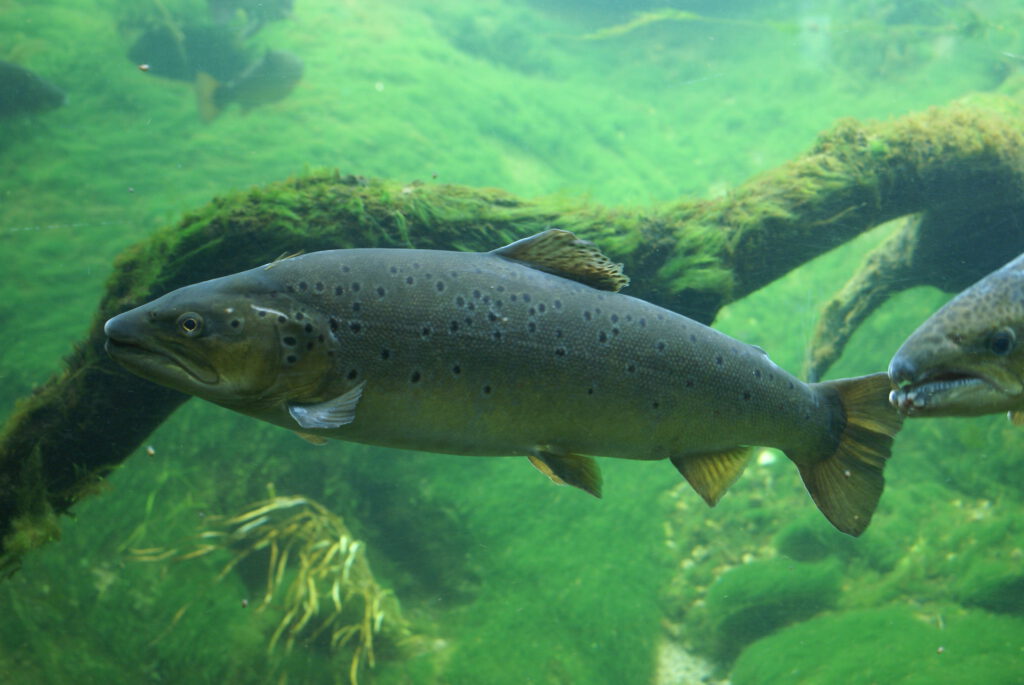
The species “salmo trutta” occurs in three forms in German waters.
As brown trout, the typical and original trout in German streams and rivers.
As lake trout in large, cold, and stagnant waters such as the pre-Alpine lakes, and as sea trout, which spends its growth phase in coastal waters of the North Sea and Baltic Sea.
The three forms differ in their migratory behavior. Migratory behavior, in turn, depends on the type of water in which the trout lives.
If the distance to the sea is not far, a large proportion of brown trout will turn into sea trout. Near a large lake, they will turn into lake trout. Nature ensures that the habitat is used to its best advantage by the respective species. The journey to the sea is risky, but the food sources are enormous compared to those in a small stream.
The habitat then shapes the appearance of the individual fish. In the stream, they remain smaller, usually no larger than 60 cm and brown with red spots. In the pre-Alpine lakes and in the sea, they grow into stately, silvery specimens weighing over 20 kg and measuring over a meter in length.
Salmo trutta is a fine example of the wonderful and mysterious underwater world with its diverse and highly adapted creatures. The original populations of brown trout, lake trout, and sea trout were virtually extinct.
Similar to salmon, migratory fish projects across the country are attempting to rebuild stocks. As a long-distance migrant, sea trout suffer particularly from obstacles that block rivers, such as weirs and hydroelectric power plants.
The number of cormorants and other fish-eating birds has increased significantly in recent decades. When large lakes freeze over in winter, large numbers of cormorants sometimes invade the trout’s refuges in small streams during the spawning season to meet their enormous food requirements.
In this way, they endanger the last remaining genetic reserves of native trout.