
Sturgeons originally lived in most German waters.
The largest representative of the sturgeon family, the beluga (Huso huso), spawned in the Danube, among other places, and migrated to the Black Sea to reach its extraordinary size of up to 8 meters and a weight of 1,500 kg. (See also the migratory fish database of historical catches in the Caspian Sea.)
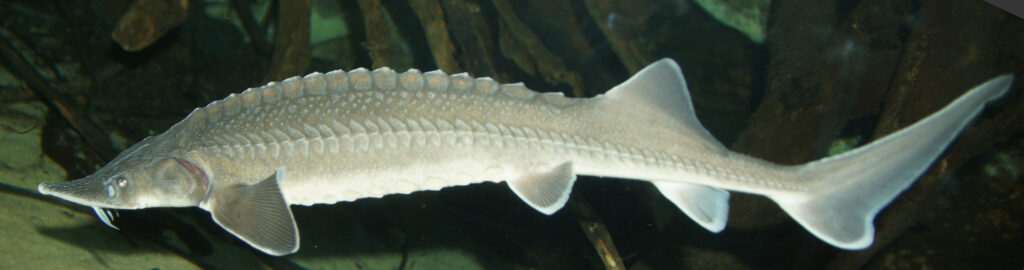 © Stefan Ludwig
The smallest German sturgeon species, the sterlet (Acipenser ruthenus), also lives in the Danube and grows to a maximum length of one meter. Further information on the sterlet can be found at: Life Sterlet, EU project LIFE Sterlet completed: over 235,000 young fish released into the Danube and March rivers!
The European sturgeon (Acipenser sturio) and the Atlantic or Baltic sturgeon (Acipenser oxyrinchus) populated the rivers that flow into the North Sea, Baltic Sea, and Atlantic Ocean. They also reached impressive sizes, growing to 3 meters in length and weighing up to 300 kg.
There are various activities underway to reintroduce the European sturgeon to the Rhine and Elbe rivers. Further information can be found at: Reintroduction of European sturgeon | BFN, Renewed release of 250 European sturgeon into the Rhine – De Rijn Verbindt
The Atlantic or Baltic sturgeon is being reintroduced in the Baltic Sea region (in Germany/Poland in the Oder). Information can be found at: Reintroduction of Baltic Sturgeon | BFN, MdLFA_Heft65.pdf, HaffStör | IGB
 © Stefan Ludwig
All sturgeons resemble sharks in shape and appear primitive with the bony plates covering their bodies. In fact, sturgeons are very ancient species in terms of evolutionary history. Sturgeons provide caviar. Beluga caviar is the roe (eggs) of the beluga sturgeon. Sturgeon meat is also extremely tasty.
 © Stefan Ludwig
One reason for the extinction of sturgeon in Germany and their severe endangerment worldwide is overfishing. As migratory fish, however, they also depend on free access to their spawning grounds.
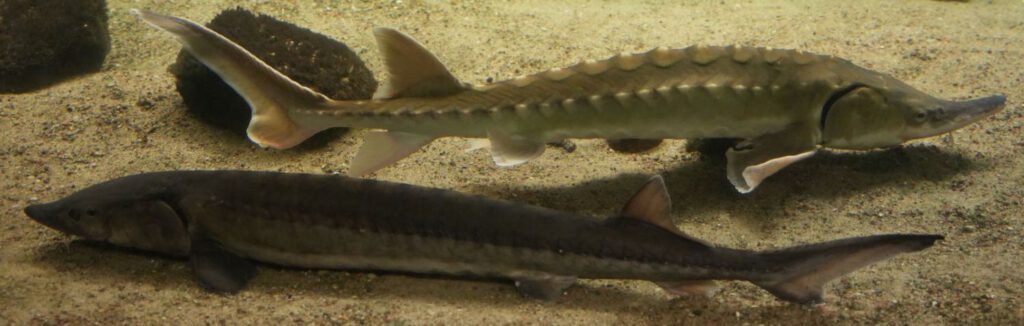 © Stefan Ludwig
Migration barriers are a major reason why sturgeons have not yet been successfully reintroduced in Germany despite intensive efforts. The idea that sturgeons weighing up to a ton migrated in the Danube as far as the Ulm area gives us an idea of the breathtaking natural experiences that people today are no longer able to enjoy.